
Tell us about your project and we’ll follow up with a clear, no‑pressure quote and timeline.
The short version
Based on published market rates across Florida, fully installed paver projects typically run $12 to $32 per square foot, including excavation, a compacted base, bedding sand, edge restraints, the pavers themselves, and labor. Where you land in that range depends mostly on material choice, not the installer, concrete pavers, travertine, and porcelain all have very different material costs before labor even enters the picture.
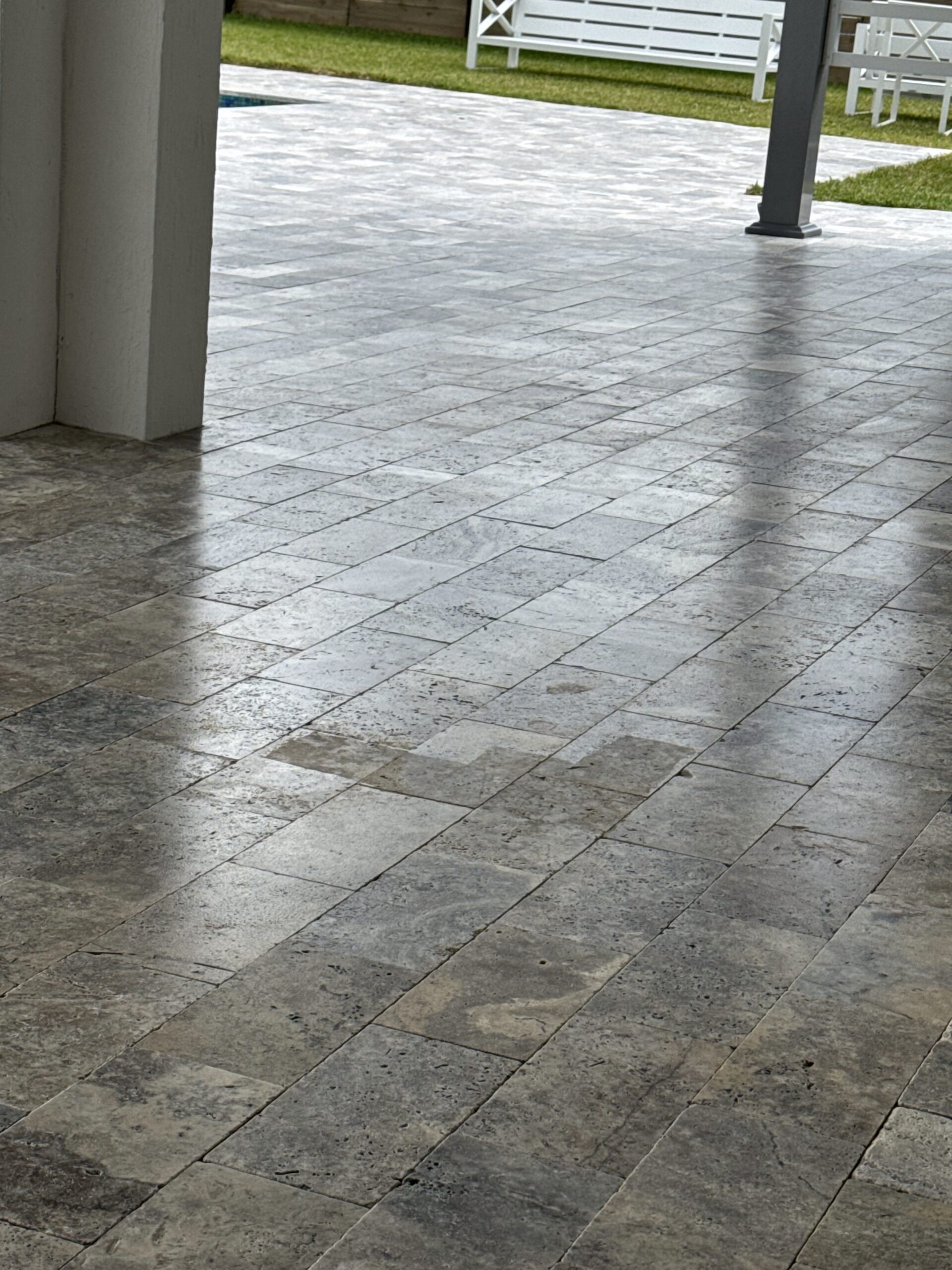
Standard concrete pavers run the most affordable, typically $12 to $18 per square foot installed. Travertine and brick pavers land in the middle, around $14 to $28 per square foot, with the range depending on stone grade and pattern complexity. Porcelain and premium natural stone sit at the top, $22 to $32 per square foot, reflecting both material cost and the more careful installation these materials require.
A 400 square foot patio (a common 20×20 size) in South Florida typically runs $4,800 to $12,800 installed, depending on material. A 500 square foot driveway runs roughly $6,000 to $8,000 in concrete pavers, or $8,500 to $14,000 in travertine. A full 1,000 square foot project spans $12,000 to $32,000 depending on material and site conditions. These are general market ranges, not a quote, exact site conditions like drainage, existing surface removal, and access can shift the number in either direction.
A complete installation isn’t just laying pavers on dirt. It includes excavating to the right depth, compacting a proper base material in layers (not just once), adding bedding sand, setting the pavers in your chosen pattern, cutting edge pieces to fit, and installing edge restraints to keep the whole surface from spreading over time. Skipping any of these steps is how a paver installation ends up sinking or shifting within a couple of years, and it’s also the hardest thing to verify after the fact, since the base is buried under the finished surface.
New pavers should be sealed after installation, and it’s a separate line item most first-time quotes leave out. Sealing generally runs $0.75 to $1.50 per square foot on top of installation, and our full sealing cost breakdown covers what affects that price. Some installers include a first seal in the installation quote; always confirm whether it’s included before comparing bids, since a quote that looks cheaper upfront may just be pushing that cost to a separate invoice later.
The biggest swing factor beyond material is site condition: removing an old concrete slab or existing pavers first, correcting poor drainage, or working around tight access all add cost that a bare square-footage number doesn’t capture. A quote that seems unusually low compared to others is worth asking specifically what base depth and material they’re using, cutting corners on the base is invisible until the pavers start moving.
Planning a new driveway, patio, or pool deck? See our paver installation page or request a free estimate and we’ll give you an exact number for your project.
| Material | Cost per Sq Ft Installed | 500 sq ft Project |
|---|---|---|
| Concrete pavers | $12-$18 | $6,000-$9,000 |
| Brick pavers | $14-$24 | $7,000-$12,000 |
| Travertine | $17-$28 | $8,500-$14,000 |
| Porcelain / premium natural stone | $22-$32 | $11,000-$16,000 |
Ranges reflect published South Florida market rates and include excavation, base, sand, edge restraints, pavers and labor. Sealing is billed separately at $0.75-$1.50/sq ft.
The single biggest factor in how long an installation actually lasts is buried where you can’t see it after the job is done: the compacted base. Industry standards generally call for a minimum 4 inches of compacted base material under a pedestrian patio and 6 to 8 inches under a driveway that carries vehicle weight, compacted in layers (called lifts) rather than all at once, since compacting 8 inches of loose material in a single pass doesn’t achieve proper density all the way through. Skimping here is invisible on installation day and doesn’t show up as a problem until 1 to 3 years later, when pavers start sinking or shifting under regular use. If you’re comparing quotes, ask specifically what base depth and compaction method each contractor uses, a noticeably cheaper bid is sometimes cutting corners exactly here.
Permit requirements for paver installation vary by municipality across Miami-Dade and Broward, but as a general pattern, driveway and walkway paver installations often fall under standard hardscape permitting when they involve grading or drainage changes, while smaller patio projects sometimes don’t require one at all. Pool deck pavers installed alongside new pool construction are typically covered under the pool permit itself. Since requirements genuinely differ city by city, and even sometimes by HOA on top of the municipal requirement, always confirm with your specific city’s building department rather than assuming based on a neighbor’s project or a general rule.
A typical 500 square foot driveway runs roughly $6,000 to $8,000 installed in concrete pavers, or $8,500 to $14,000 in travertine, based on published market rates. Exact pricing depends on site conditions and material choice.
Not always. Sealing typically runs $0.75 to $1.50 per square foot as a separate line item. Always confirm with any installer whether the first seal is included or billed separately.
It comes down to material cost. Concrete pavers are manufactured and widely available, while travertine and natural stone are quarried and porcelain requires more careful handling and installation, all of which adds to material and labor cost.
Site conditions are usually the biggest factor: removing an existing surface, correcting drainage, or working around tight access all add cost beyond the base material price.
Driveway bases generally need to be deeper than patio bases since they handle vehicle weight, typically requiring more compacted base material in layers. A base that’s too shallow is a common cause of sinking or shifting pavers within a few years.
In most cases the base installation and sealing happen as separate steps, since new pavers need time to settle before sealing. See our paver installation page for the full process.
Short, practical articles to help you keep your driveway, patio, and pool deck looking freshly sealed between professional visits.


South Florida homeowners trust us to clean, sand, and seal their pavers the right way the first time, here’s what they’re saying after seeing their driveways, patios, and pool decks transformed.
Broward County, Miami-Dade County, & Monroe County